Thread Management: Organization Tips for Stitchers
Thread Management: Organization Tips for Stitchers
Let’s be honest: every cross-stitcher eventually faces The Tangle. That moment when you reach into your bag of loose embroidery floss and pull out a knotted mess of DMC 310, DMC 321, and something that might be DMC 3799 but the label fell off weeks ago. A little organization goes a long way — and the right system depends on the size of your collection and how you like to stitch.
Floss Bobbins: The Classic Approach
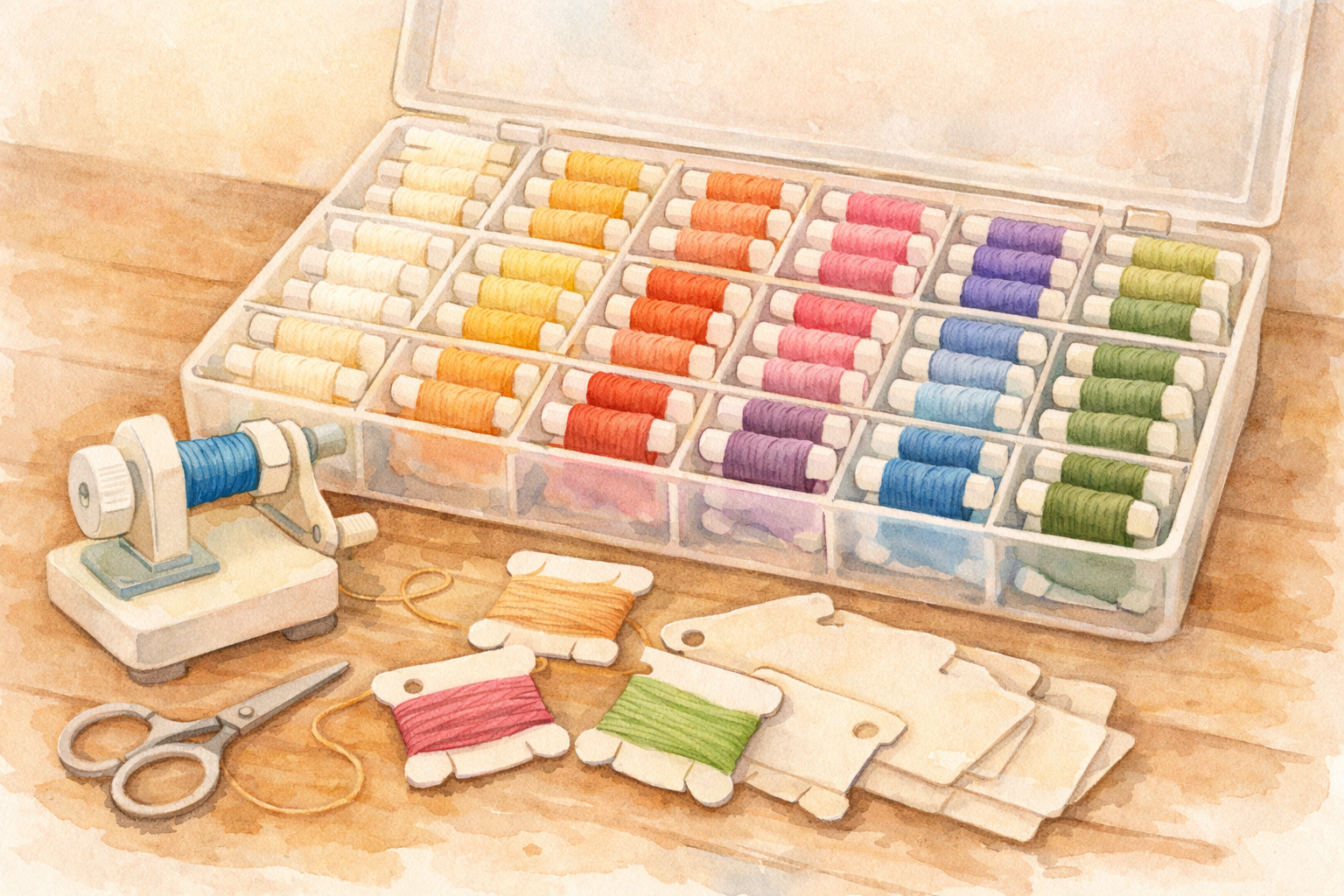
Cardboard or plastic floss bobbins are the most popular organization method, and for good reason. You wind each skein of floss onto a bobbin, label it with the DMC number, and store the bobbins in a box or binder.
Setting Up a Bobbin System
- Buy bobbins — they’re incredibly cheap. You can get 100 cardboard bobbins for a few dollars, or invest in sturdy plastic ones.
- Wind your floss onto each bobbin. Don’t cut the skein — just wrap it around the bobbin. If you need to separate strands, pull them from the wound bobbin as needed.
- Write the DMC number on the bobbin. Use a permanent marker, or if you’re using cardboard, many come with pre-printed number spaces.
- Store in numerical order in a compartmentalized box or a bobbin ring.
Pros
- Easy to find colors by number
- Bobbins prevent tangles almost entirely
- Compact storage — dozens fit in a small box
- You can see at a glance how much thread you have left
Cons
- Winding takes time upfront (put on a podcast — it goes fast)
- Some stitchers feel winding adds unnecessary kinks to the floss
- If your collection grows large, you need multiple boxes
Project Bags: Keep It Simple
Some stitchers prefer to organize by project rather than by number. Each project gets its own bag containing only the threads needed for that pattern.
How Project Bags Work
- Pull all the colors you need for a specific pattern.
- Cut lengths or keep partial skeins, bundled together.
- Store in a small zip-top bag, project pouch, or even a ziplock with the pattern name on it.
- When you sit down to stitch, you grab one bag and everything is right there.
Pros
- No winding or elaborate systems
- Perfect for stitchers who work on 1-2 projects at a time
- Easy to grab and go
- Low setup cost
Cons
- Doesn’t help you track your overall thread inventory
- Partial skeins from finished projects end up homeless
- Can get messy inside the bag if you’re not careful
Floss Bobbins
- • Easy to find colors by number
- • Prevents tangles almost entirely
- • Compact storage — dozens fit in a small box
- • See at a glance how much thread remains
- • Great for building a long-term collection
Project Bags
- • No winding or elaborate setup needed
- • Perfect for 1-2 projects at a time
- • Easy to grab and go
- • Low setup cost
- • Everything for one project in one place
Zip Bags on a Ring: The Visual Method
A popular middle-ground approach: put each skein in its own tiny zip-top bag, label it, and clip the bags onto a binder ring or carabiner.
Setting It Up
- Get small 2x3-inch zip bags (available in bulk online).
- Place one skein per bag. If the DMC label is intact, leave it in the bag for reference.
- Write the DMC number on the bag with a permanent marker.
- Thread the bags onto a ring in numerical order or group by color family.
Pros
- You can see the actual thread color through the bag
- Easy to add or remove colors
- Lightweight and portable
- No winding required
Cons
- Takes up more physical space than wound bobbins
- Bags can get staticky and annoying
- Harder to tell at a glance how much floss remains
Creating a Thread Inventory
Once your collection grows beyond a dozen colors, you’ll want to track what you own. This prevents buying duplicates and helps you quickly check whether you already have the colors for a new pattern.
Spreadsheet Method
Create a simple spreadsheet with columns for:
- DMC number
- Color name
- Quantity (full skeins vs. partial)
- Notes (e.g., “needed for current project”)
Sort by DMC number. Update it each time you buy or finish a skein. Google Sheets works great for this since you can access it from your phone at the craft store.
App Method
Several apps exist specifically for tracking embroidery thread:
- Thread Organizer and My Floss are popular mobile apps that let you scan DMC numbers, mark what you own, and check against pattern requirements.
- Some pattern software includes built-in inventory features.
The best system is the one you’ll actually update. If spreadsheets feel like homework, use an app. If apps feel fiddly, use a spreadsheet. If both feel like too much, at minimum keep your bobbins in numerical order — that alone prevents most “do I own this color?” confusion.
Project-Specific Organization
When starting a new project, pulling and organizing threads upfront saves enormous time later.
The Pull-and-Label Method
- Look at your pattern’s thread key.
- Pull each required skein from your stash.
- Cut a working length (about 18 inches) and set it on a thread organizer card, bobbin ring, or a strip of cardboard with holes punched along the edge.
- Label each thread with its symbol from the pattern, not just the DMC number. When you’re stitching and the pattern shows a triangle symbol, it’s faster to look for “triangle” than to look up “DMC 3768” every time.
Thread Organizer Cards
These are simple cards (often included with kits) with holes along one side. You loop each color through a hole and label it. They keep your project threads sorted, untangled, and immediately accessible.
You can buy them or make your own from cardboard. Punch holes with a hole punch, loop threads through, and write the symbol and DMC number next to each hole.
Storing Leftover Thread
After finishing a project, you’ll have partial skeins. Don’t toss them — even small amounts are useful for future projects, repairs, or small motifs.
If you use a bobbin system: Wind the leftovers onto labeled bobbins and return them to your main storage. Easy.
If you don’t: Keep a “leftovers” zip bag or small box. Wrap each partial skein around a scrap of cardboard with the DMC number written on it. Once a year, consolidate: if you have enough partial skeins to justify a bobbin system, make the switch.
Tip
The point is: always keep the DMC number with the thread. Unlabeled partial skeins are practically useless because matching a color by eye to its exact DMC number is nearly impossible — many colors look identical until they’re side by side.
Thread Conditioners
Thread conditioners reduce tangling, static, and fraying while you stitch. They’re not strictly necessary, but many experienced stitchers swear by them.
Info
Thread Heaven
A silicone-based conditioner that you run your thread across before stitching. It reduces static and prevents the thread from twisting and knotting. The blue container lasts for years. Thread Heaven is the preferred choice for most cross-stitchers because it doesn’t leave a waxy residue.
Beeswax
Traditional thread conditioner that coats the thread with a thin layer of wax. It strengthens the thread and prevents fraying, which is useful for metallics and overdyed threads that tend to shred. However, beeswax can leave a slight residue and may attract dust over time.
When to Condition
- Metallic threads: Almost always. They’re notorious for shredding and tangling.
- Dark threads: DMC 310 (black) and other dark colors can be rougher and benefit from conditioning.
- Overdyed and hand-dyed threads: These can be delicate and fray easily.
- Regular DMC cotton: Optional. Some stitchers condition everything; others find it unnecessary for standard cotton floss.
How Much Thread to Buy
Running out of a color mid-project is frustrating, especially if the dye lot has changed by the time you buy more. Here’s a rough guide:
One standard DMC skein (8 meters/8.7 yards) covers approximately:
- About 140-155 full cross-stitches on 14-count Aida using 2 strands
- About 180-200 full cross-stitches on 18-count Aida using 2 strands
Most patterns include a thread estimate. If they don’t, count the total stitches per color on the chart (many pattern software tools calculate this) and divide by 140 to estimate skeins needed for 14-count.
Warning
Always buy one extra skein of colors used heavily in the pattern. The cost of an extra skein (less than a dollar) is nothing compared to the frustration of running out and discovering a different dye lot.
Labeling Systems That Work
Whatever organization method you choose, labeling is everything. Here are the systems stitchers rely on:
- Write on the bobbin or bag: Simple, effective, permanent.
- Printed DMC stickers: Available in sheets online. Peel and stick onto bobbins. Clean and professional-looking.
- Keep the original skein label: Tuck it into the bag or tape it to the bobbin. These include the color name, number, and dye lot.
- Color-coded dots: Some stitchers add colored stickers to group color families (all blues, all greens) for faster visual scanning.
Continue Learning
Ready to put your organized stash to use?
- Getting Started with Cross-Stitch — covers thread basics for beginners
- Organizing Your Cross-Stitch Stash — beyond thread: organizing fabric, tools, and patterns
- Common Cross-Stitch Mistakes and How to Fix Them — prevent thread-related problems before they start
- A Guide to Cross-Stitch Fabrics — pair the right thread weight with the right fabric
More Articles
Traveling with Your Cross-Stitch Projects
Cross-stitch is the perfect portable craft. Learn how to pack your projects for travel, navigate airport security, and keep stitching wherever you go.
Organizing Your Cross-Stitch Stash
Fabric, floss, patterns, tools — your cross-stitch collection grows fast. Practical storage and organization strategies to keep your stash tidy and accessible.
Stitching on Dark and Colored Fabrics
Dark and colored fabrics create stunning effects but come with unique challenges. Master the techniques for working with black, navy, and colored Aida and evenweave.