Organizing Your Cross-Stitch Stash
Organizing Your Cross-Stitch Stash
It starts innocently. A few skeins of floss, a couple of fabric pieces, maybe a pattern book. Then one day you open a drawer and realize you have 200 skeins of DMC, three half-finished projects, a tower of fabric, and absolutely no idea whether you already own DMC 3371. Sound familiar?
Cross-stitch supplies multiply quietly, and without a system, you’ll waste money re-buying thread you already have and waste time hunting for supplies you know are “somewhere.” Here’s how to get your stash under control.
Thread Storage
Thread is usually the biggest organizational challenge because of the sheer number of colors. DMC alone makes nearly 500 colors of standard embroidery floss. Here are the most popular storage systems, from simplest to most involved.
Plastic Bobbins in a Binder or Box
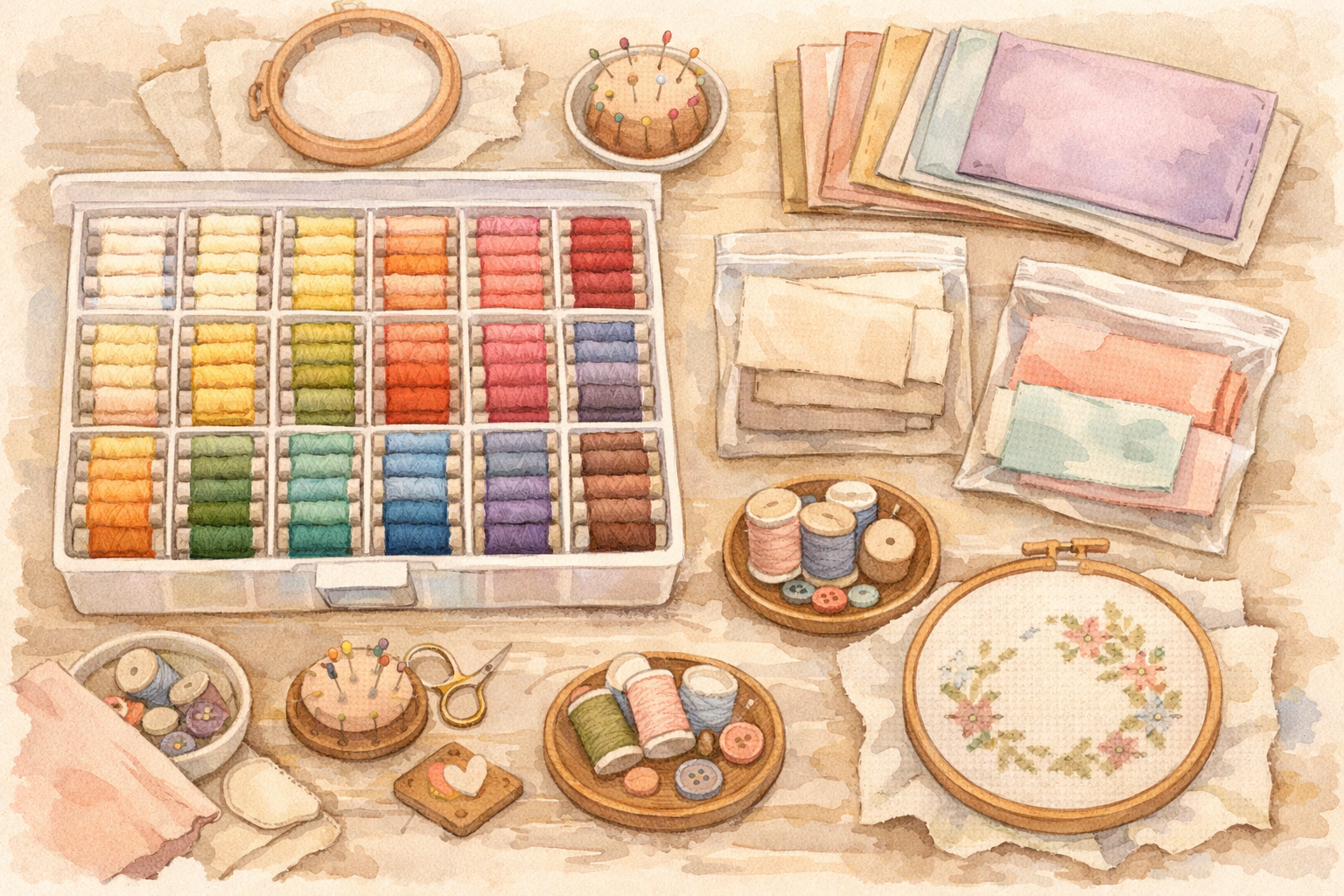
This is the gold standard for most stitchers. Wind each skein of floss onto a flat plastic or cardboard bobbin, label it with the DMC number, and store the bobbins in a compartmentalized box or a zippered binder with plastic pockets.
Bobbin boxes: DMC-branded bobbin boxes hold about 50 bobbins each in individual slots. You can arrange by number or by color family. These stack neatly and are easy to flip through.
Binder systems: Three-ring binders with clear plastic bobbin pages (each page holds 20–30 bobbins) let you organize your entire collection in one portable unit. You can sort by DMC number, color family, or however makes sense to you.
Tips for bobbin storage:
- Always label bobbins with the DMC number before you lose the wrapper
- Wind bobbins loosely — tight winding can stretch the floss
- Keep a master list (paper or digital) of all the colors you own so you can check it before buying
Floss Bags on a Ring
An alternative to bobbins: put each skein in a small resealable bag (or fold it into a DMC-style skein tag), label it, and thread the bags onto a large binder ring or carabiner. This keeps the floss in its original skein form and is very portable.
Thread Organizer Cards for Active Projects
For a project in progress, cut your working threads and loop them through holes in a cardboard or plastic organizer card. Label each hole with the symbol and DMC number from your pattern. This keeps your current project’s threads separate from your main stash and makes color changes fast.
Not sure which thread storage system is right for you? Here is a side-by-side comparison:
Bobbin Box System
- • Easy to browse and find colors quickly
- • Compact and stackable storage
- • Neat, uniform appearance
- • Works well for large collections (200+ colors)
- • Binder systems make entire collection portable
Bags on Ring System
- • Keeps floss in original skein form
- • No winding time required
- • Highly portable on a carabiner or ring
- • Easy to pull individual colors for a project
- • Great for smaller collections or travel kits
Fabric Storage
Fabric needs a bit more care than thread because it’s susceptible to creasing, discoloration, and dust.
Tip
The Golden Rule: Roll, Don’t Fold
Folded fabric develops creases that can be difficult (sometimes impossible) to remove completely, especially on specialty fabrics. Roll your fabric around a cardboard tube (wrapping paper tubes work perfectly) and secure it with a clip or rubber band.
Protecting from Light and Dust
Store fabric away from direct sunlight, which can yellow or fade it over time. A closet shelf, a covered bin, or a fabric storage bag all work well. For long-term storage, wrap rolls in acid-free tissue paper to prevent any chemical interaction between the fabric and storage materials.
Labeling Your Fabric
Tape or pin a small note to each piece listing:
- Fabric type (Aida, evenweave, linen)
- Count (14ct, 18ct, 28ct, etc.)
- Color name
- Size / dimensions
- Where you bought it (helpful for reordering)
Scraps and Leftovers
Don’t throw away fabric scraps. Pieces too small for a full project are perfect for testing new techniques, practicing stitches, testing thread colors, or small ornament projects. Keep a bag or bin of scraps sorted roughly by fabric type.
Pattern Storage
Digital Patterns
Most patterns purchased online come as PDF files. Build a folder structure on your computer or cloud storage:
Cross-Stitch Patterns/
├── To Stitch/
├── In Progress/
├── Completed/
└── Reference/
Back up your digital patterns. If your computer dies and you only had the PDFs locally, those purchases are gone. Use a cloud service like Google Drive, Dropbox, or iCloud. Some stitchers also keep copies on a USB drive as a second backup.
Info
Printed Patterns and Charts
Keep printed patterns in a binder with clear sheet protectors. This keeps them flat, clean, and easy to reference while stitching. If you’re working from a pattern book, photocopy the page you’re using so you can mark it up without damaging the original.
Pattern Inventory
Maintain a simple list of all patterns you own, whether you’ve stitched them, and which ones are in your “to stitch” queue. This prevents accidentally buying duplicate patterns — something that happens more often than anyone wants to admit.
Work in Progress (WIP) Management
Most stitchers have at least one project going at any time, and many have several. Each WIP needs its own organizational space.
Project Bags
Dedicate a bag to each active project. Inside the bag, keep:
- The fabric (on hoop, frame, or scroll rods)
- The pattern (printed copy or tablet)
- Thread organizer card with the project’s working threads
- Any notes about where you left off
- A needle minder or needle case
Zippered pouches, drawstring bags, and dedicated cross-stitch project bags (like those from Zippity-Do-Done or similar craft brands) all work well. The key is that each project is self-contained — you can grab one bag and have everything you need.
Grime Guards
Tip
A grime guard is a fabric sleeve that wraps around the inner ring of your embroidery hoop, protecting the exposed fabric from oils, dirt, and handling marks. If you stitch in hand (holding the hoop) and carry projects around, grime guards are well worth the small investment. Many Etsy sellers make them in fun fabrics.
Tracking Where You Left Off
Before you put a project down — especially if you might not pick it up again for days or weeks — leave yourself a note. Write down:
- The last symbol/area you stitched
- The page or section of the pattern you were on
- Any issues you noticed (miscounted section, thread running low, etc.)
Some stitchers take a photo of their progress and the corresponding chart section. Future-you will be grateful.
Tool Organization
Needles
Keep needles in a needle case, needle minder, or magnetic strip — never loose in a bag where they can poke through or get lost. A small magnetic needle case is ideal: it keeps needles visible, organized, and secure.
Scissors
Small, sharp embroidery scissors are essential. Keep them in a scissor sheath or fob (many stitchers attach a decorative fob to their scissors so they’re easy to spot). Never use your embroidery scissors on paper or other materials — it dulls them.
Hoops, Frames, and Stands
If you have multiple hoops and frames, a simple approach is a hanging fabric organizer (the kind designed for closets) or a deep drawer. Nesting smaller hoops inside larger ones saves space. Scroll frame rods can be stored in a tall bin or leaned in a closet corner.
Small Accessories
Items like needle threaders, laying tools, marking pens, tape measures, and magnets tend to scatter. A small zippered pouch or a designated section of a craft caddy keeps these together and accessible.
Inventory Tracking
Once your stash reaches a certain size, you’ll want a way to check what you have without digging through bins.
Simple Approaches
- Spreadsheet: A basic spreadsheet with columns for DMC number, color name, and quantity works perfectly. Update it when you buy or use up a color.
- Checklist: Print a DMC color card checklist and highlight the colors you own. Tuck it into your stitching bag for shopping trips.
Apps and Digital Tools
- Thread organizer apps: Several mobile apps (like Thread Organizer and Floss Tracker) let you scan or search for DMC numbers and track your collection.
- Notes app: Even a simple notes app on your phone with a running list works better than nothing.
The best system is the one you’ll actually maintain. A fancy spreadsheet you never update is worse than a scribbled list you keep current.
Budget-Friendly Storage Solutions
You don’t need expensive craft-specific storage. Here are thrifty alternatives:
- Plastic bead organizers from the dollar store work perfectly for bobbin storage
- Shoe boxes lined with tissue paper store fabric rolls nicely
- Binder clips hold pattern pages to a clipboard while stitching
- Small food storage containers organize buttons, charms, and small accessories
- Resealable sandwich bags labeled with a marker make instant thread bags
- Over-the-door shoe organizers provide pocket storage for small projects, tools, and thread
Dealing with a Growing Stash
At some point you might look at your collection and wonder if you’ve gone overboard. A few principles for keeping things manageable:
- One in, one out — for every new project you start, try to finish (or consciously set aside) an existing one
- Destash periodically — sell or gift supplies you know you won’t use. Cross-stitch Facebook groups and subreddits often have destash threads
- Be honest about your stitching pace — if you buy patterns faster than you stitch them, your “to stitch” pile will only grow. That’s fine if it brings you joy, but don’t let it become a source of guilt
- Organize before you buy — you might discover you already own what you were about to purchase
Further Reading
- Master your thread management with our thread management and organization tips
- Decide between kits and patterns with our kits vs. patterns comparison
- Stitching on the go? Read our guide to traveling with cross-stitch projects
More Articles
Traveling with Your Cross-Stitch Projects
Cross-stitch is the perfect portable craft. Learn how to pack your projects for travel, navigate airport security, and keep stitching wherever you go.
Stitching on Dark and Colored Fabrics
Dark and colored fabrics create stunning effects but come with unique challenges. Master the techniques for working with black, navy, and colored Aida and evenweave.

Gridding Your Fabric: Techniques for Accurate Stitching
Gridding your fabric creates a visual guide that makes counting almost foolproof. Learn thread gridding, pen gridding, and other methods to keep your stitches on track.