Choosing Your First Cross-Stitch Project
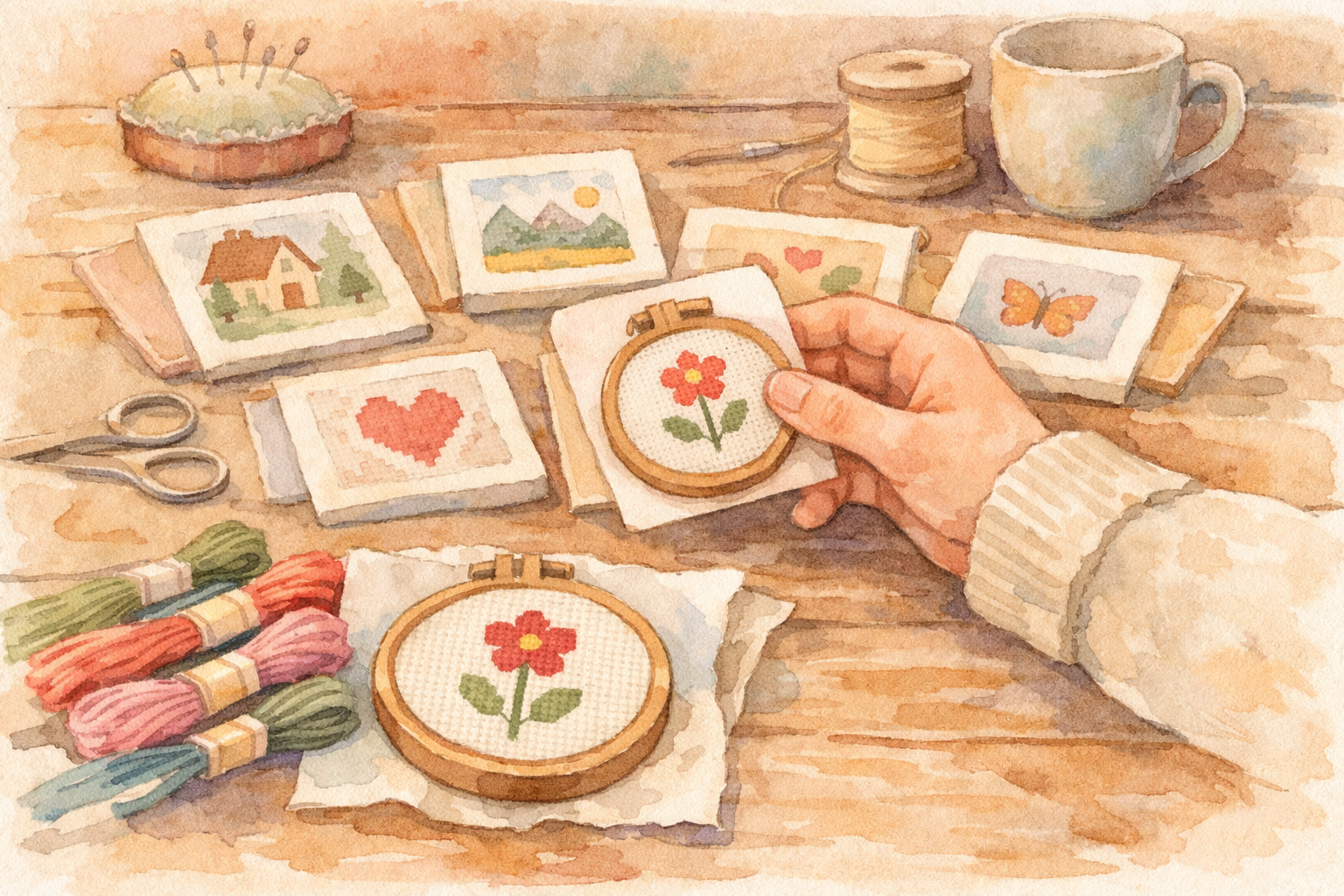
Choosing Your First Cross-Stitch Project
You’ve got your supplies, you’ve learned the basic stitch, and now comes one of the most exciting decisions: what should you actually stitch? Your first project sets the tone for your entire cross-stitch journey, so let’s find something that will keep you motivated and proud of the result.
What Makes a Good Beginner Project
Not all patterns are created equal when it comes to beginner-friendliness. Here’s what to look for:
Small Size (Under 5 x 5 Inches)
Your first project should be something you can finish in a reasonable time. A small design, roughly 40-70 stitches wide and tall, will take most beginners a few evenings to a couple of weeks. Completing a project quickly builds confidence and excitement for the next one.
Tip
Avoid the temptation to jump straight into that stunning full-coverage landscape that’s 300x400 stitches. Those are marathons, and you want to start with a satisfying sprint.
Limited Color Palette (3-8 Colors)
Fewer colors means less thread management and fewer opportunities for confusion. A 5-color design lets you focus on perfecting your technique without constantly switching threads and checking the pattern key.
As a bonus, kits with fewer colors cost less, which is nice while you’re still exploring the hobby.
Simple Shapes and Clear Sections
Look for patterns with distinct color blocks rather than tons of confetti stitching (scattered single stitches of different colors). Designs with clear sections, such as a simple flower, a word or phrase, a geometric pattern, or a cartoon character, are much easier to follow.
Confetti-heavy patterns require constant color changes and precise counting. Save those for when you’ve built up your confidence.
14-Count Aida Fabric
As we covered in the getting started guide, 14-count Aida is the sweet spot for beginners. The holes are clearly visible, the squares are easy to count, and most beginner patterns are designed for this fabric count.
Some kits include fabric; make sure it’s 14-count unless you’re feeling adventurous.
Great First Project Ideas
Info
Kits: The Easiest On-Ramp
Cross-stitch kits include everything you need: fabric, thread, needle, pattern, and instructions. They take all the guesswork out of gathering supplies. Look for kits labeled “beginner” or “easy” from brands like Dimensions, Bucilla, or smaller independent designers on Etsy.
A kit ensures the colors are pre-selected and harmonious, the fabric is the right size, and you have enough thread to finish.
Small Samplers
Traditional samplers featuring the alphabet, simple borders, or rows of small motifs have been teaching stitchers for centuries. They’re repetitive in a good way, which means lots of practice on the same stitches. Modern mini-samplers with fun quotes or phrases are wildly popular.
Geometric Patterns
Hearts, stars, simple mandalas, or pixel art designs are excellent choices. Their symmetry makes counting easier since you can mirror what you’ve already stitched. And geometric designs look impressive even at a small size.
Small Characters or Icons
A tiny cactus, a simple cat face, a cup of coffee, a small rainbow: these miniature designs are quick wins that look charming framed or as ornaments. Many free patterns online fall into this category and are specifically designed for beginners.
Bookmarks
Cross-stitch bookmarks are narrow, quick to finish, and immediately useful. They’re a great way to practice technique on a project with a built-in purpose. Plus, they make wonderful gifts.
What to Avoid for Your First Project
Full-Coverage Designs
Patterns where every single square of fabric is covered with stitches are beautiful but exhausting for beginners. They require perfect tension and leave no room for the fabric to “breathe.” Save these for your fifth or sixth project.
Lots of Backstitch
While backstitch outlines add beautiful definition, patterns that rely heavily on backstitch and specialty stitches add complexity. For your first project, stick to designs that are primarily full cross-stitches.
Patterns on Dark Fabric
Stitching on black or navy Aida is challenging because the holes are hard to see. White or light-colored fabric is much more forgiving and easier on the eyes.
Oversized Patterns
Anything over 100 stitches in either dimension is a significant commitment for a beginner. There’s no shame in starting small. Many experienced stitchers still enjoy small, quick projects between larger works.
Setting Yourself Up for Success
Read the Whole Pattern First
Before you thread your needle, look over the entire pattern. Identify the different colors, find the center, and get a mental picture of how the design is laid out. This prevents surprises halfway through.
Organize Your Thread
If you’re not using a kit, wind your DMC threads onto bobbins or cardboard and label them with their color numbers. This small investment of time prevents tangles and makes color identification instant.
Warning
Prepare Your Fabric
Cut your fabric at least 3 inches larger than your finished design on all sides. This gives you enough margin for framing later. If your fabric is wrinkled, iron it gently before starting.
Whip-stitch or tape the edges to prevent fraying as you work.
Track Your Progress
Take photos as you stitch! It’s incredibly motivating to see how far you’ve come, and you’ll want to remember the journey of your first piece. Share your progress with the cross-stitch community online for encouragement and tips.
When You Finish
Congratulations on your first piece! Here’s what to do:
- Wash it gently in lukewarm water with a drop of mild soap to remove oils from your hands and any fabric pen marks.
- Dry it flat on a clean towel, reshaping as needed.
- Iron it face-down on a soft towel to avoid flattening your stitches.
- Frame it, hoop it, or make it into something: Small embroidery hoops make instant frames. Or tuck your piece into a greeting card, turn it into a coaster, or mount it in a picture frame.
Display your first finished piece proudly. Every expert cross-stitcher started exactly where you are now, and looking back at your first project will always bring a smile.
Free Pattern Resources
You don’t need to spend money to find great beginner patterns. Here are reliable sources for free designs:
Online Communities
- r/CrossStitch on Reddit frequently shares free patterns and many designers post free mini-designs
- Pinterest is filled with free cross-stitch patterns, though quality varies — look for patterns with clear symbols and legends
- DeviantArt has a dedicated cross-stitch community with many free pixel art patterns
Designer Websites
Many cross-stitch designers offer a selection of free patterns on their websites as samplers of their work. These are often high quality since they represent the designer’s brand. Check the websites of designers whose style you admire.
Stitch Squad Patterns
Browse our pattern collection and filter by difficulty to find beginner-friendly designs. You can view pattern details before deciding, so you know exactly what you’re getting into.
What to Look for in Pattern Reviews
When considering a pattern (free or paid), reviews from other stitchers are invaluable:
Green Flags
- “The chart was easy to read” — Clear symbols and well-organized legend
- “Colors were accurate” — The thread colors match the preview image
- “Good instructions for beginners” — Step-by-step guidance included
- “Stitch count was correct” — No errors in the pattern
Red Flags
- “Many errors in the chart” — Multiple stitchers reporting mistakes is a dealbreaker
- “Colors look nothing like the picture” — Poor color selection by the designer
- “Confusing symbols” — Too many similar-looking symbols make stitching frustrating
- “No thread list” — A pattern without a complete color key is incomplete
Reading Between the Lines
If a pattern has mixed reviews, look at what specific issues people mention. A single complaint about “too many colors” might just mean it’s ambitious, not poorly designed. But consistent reports of chart errors are a real problem.
Realistic Time Estimates by Project Size
One of the most common questions beginners ask is “how long will this take?” While stitching speed varies by person, here are rough guidelines based on moderate pace:
Tiny (Under 3,000 stitches)
- Examples: Small motifs, bookmarks, ornaments
- Dimensions: ~40x40 or smaller
- Time estimate: 5-15 hours
- Perfect for: Absolute beginners, quick gifts, testing new techniques
Small (3,000-10,000 stitches)
- Examples: Simple designs, small samplers, coasters
- Dimensions: ~50x70 to ~80x80
- Time estimate: 15-40 hours
- Perfect for: Building confidence, first framed piece
Medium (10,000-40,000 stitches)
- Examples: Detailed designs, text-heavy samplers, scenic pieces
- Dimensions: ~100x100 to ~150x200
- Time estimate: 40-120 hours
- Perfect for: Intermediate stitchers, projects to work on over a few months
Large (40,000+ stitches)
- Examples: Full-coverage designs, portraits, large landscapes
- Dimensions: 200x200 and up
- Time estimate: 120-500+ hours
- Perfect for: Experienced stitchers who enjoy long-term projects
Project Size & Time Calculator
Physical Size
7.1" x 5.7"
Total Stitches
8,000
Est. Time
27 hours - 53 hours
Size Category
SmallRemember: These are very rough estimates. Your speed will increase dramatically as you gain experience. A stitch that takes you 5 seconds today will take 2 seconds after a few projects. Don’t let time estimates intimidate you — cross-stitch is about the journey, not the destination.
Continue Learning
Now that you know what to look for in a project, deepen your skills with our other guides:
- Getting Started with Cross-Stitch — covers all the supplies and basic technique you’ll need
- How to Read a Cross-Stitch Pattern Chart — decode symbols, count grids, and find your starting position
- Understanding Color Theory for Cross-Stitch — choose palettes that make your projects shine
Ready to Browse?
Now that you know what to look for, explore our pattern collection and filter by difficulty to find the perfect beginner-friendly project. Filter for patterns with fewer colors and smaller dimensions to find your ideal first stitch. Happy stitching!
More Articles
Traveling with Your Cross-Stitch Projects
Cross-stitch is the perfect portable craft. Learn how to pack your projects for travel, navigate airport security, and keep stitching wherever you go.
Organizing Your Cross-Stitch Stash
Fabric, floss, patterns, tools — your cross-stitch collection grows fast. Practical storage and organization strategies to keep your stash tidy and accessible.
Stitching on Dark and Colored Fabrics
Dark and colored fabrics create stunning effects but come with unique challenges. Master the techniques for working with black, navy, and colored Aida and evenweave.